
AI Didn't Kill PR. It Made It More Valuable.
- florenceakanbi
- 2 days ago
- 4 min read
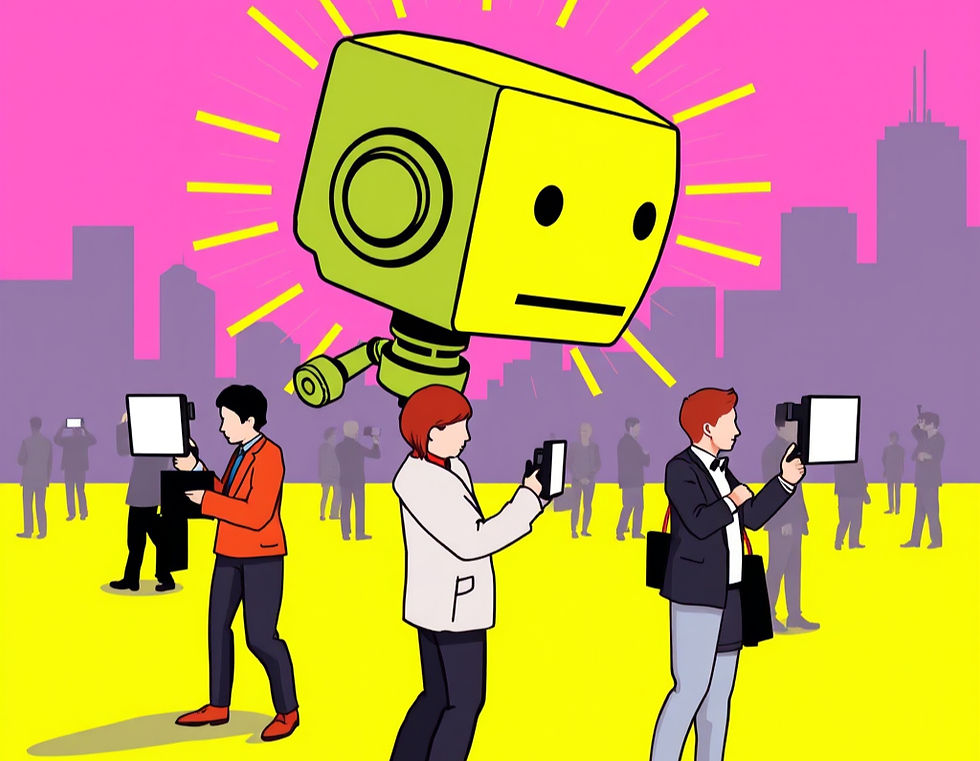
On July 16, the global communications industry paused to celebrate World PR Day, a date chosen to honour Ivy Lee, whose belief that organisations should communicate with honesty and transparency helped shape modern public relations more than a century ago. This year's theme, "The Golden Age of Strategic PR," sounded ambitious. Perhaps even optimistic.
After all, this is the same industry many believe artificial intelligence is about to disrupt.
I walked into a room expecting another conversation about how AI is changing communications.
I walked out convinced that we have been asking the wrong question all along.
The discussion wasn't about whether AI will change PR. That answer is already obvious. AI drafts press releases, summarises reports, analyses sentiment, monitors media coverage and produces campaign ideas in seconds. Those capabilities are no longer remarkable. They're expected.
The real question is what happens after everyone has access to those same capabilities.
That was the thought that lingered in my mind all through my journey home that evening.
The biggest threat to PR may also be the strongest evidence that the profession is entering one of the most important periods in its history.
That sounds contradictory until you think about what AI has actually done.
It has made creating information incredibly easy.
It has also made creating misinformation incredibly easy.
The same technology that can help a communications team write a speech can help someone else fabricate a CEO statement that never existed. It can generate convincing images of events that never happened, fake customer testimonials, synthetic videos, manipulated data and rumours that spread across platforms before anyone has time to ask whether they are true.
Information now travels faster than verification.
That changes everything.
Because once false information reaches the public, someone has to establish the facts, respond with credibility, reassure stakeholders and rebuild confidence.
That work has never belonged to software.
It belongs to people.
This is where public relations quietly becomes one of the most valuable business functions in the room.
Not because PR owns truth, but because trust has become the scarcest resource in modern communication.
That doesn't mean communications professionals automatically inherit this responsibility. Legal teams, regulators, cybersecurity specialists, platform trust and safety teams and policymakers are all working in the same space. The difference is that PR has always lived where perception, reputation and public confidence intersect.
Technology has simply raised the stakes.
The conversation reminded me of something we often forget.
People rarely remember the first story they heard.
They remember the story they believed.
The organisations that win over the next decade won't necessarily be the fastest at producing content. They'll be the fastest at earning confidence when uncertainty appears.
That requires something AI cannot manufacture.
Judgement.
A few days before the event, I found myself having another conversation about the future of communications. Someone made a comment that has refused to leave my mind.
"The most valuable toolkit in PR isn't software. It's emotional intelligence."
The more I thought about it, the more accurate it felt.
Every communications strategy eventually reaches a moment where there isn't a correct answer.
Should the organisation respond immediately or wait?
Should it apologise?
Should it say less?
Should it acknowledge uncertainty?
Should it publish information that is technically correct but likely to create unnecessary panic?
No prompt can answer those questions.
No language model carries the weight of the consequences.
Those decisions require judgement, context, ethics and empathy.
They require understanding not simply what an audience will hear, but what they will feel.
That's where strategy begins.
And strategy has always been the part of PR that machines struggle to imitate.
Interestingly, the market is already beginning to reflect this shift.
People are increasingly asking AI platforms questions they once typed into search engines.
"What company should I trust?"
"Which bank is reliable?"
"What's the best provider?"
"What do people actually think about this brand?"
Those answers were built from credibility.
Research from Muck Rack's "What Is AI Reading?" The study analysed more than one million links cited by leading AI systems and found that approximately 94% of AI citations come from non-paid sources, while earned media accounts for roughly 82% of citations. Journalism alone represents about a quarter of everything these systems reference. Paid advertising contributes only a tiny fraction. That finding deserves more attention than it has received.
For decades, PR professionals have argued that earned media creates credibility.
AI is now quietly proving the same point.
When someone asks an AI assistant about your organisation, the system isn't impressed by how much advertising you bought.
It looks for signals that other credible sources have already spoken about you.
Independent reporting.
Expert commentary.
Third party validation.
Consistent reputation.
The work communications teams have always considered valuable is becoming one of the signals AI trusts most.
Every media interview, thought leadership article, expert quote and independent feature is doing more than influencing human audiences. It is increasingly influencing how machines describe your organisation.
Perhaps the biggest lesson from World PR Day wasn't about AI at all.
It was about curiosity.
As the conversation drew to a close, Doyin Jaiyesimi, Founder of Comms Avenue, left the room with a challenge that felt refreshingly simple.
Stay curious.
Read widely.
Question assumptions.
Verify claims before repeating them.
That advice applies just as much to AI as it does to communications. We're entering an era where anyone can generate content. Far fewer people will generate understanding.
Anyone can produce a statement.
Fewer people can produce confidence.
Anyone can create noise.
Fewer people can create clarity.
Perhaps that is why this year's theme is profound.
"The Golden Age of Strategic PR" isn't a celebration of what the profession has already achieved.
It's a reminder of what the world suddenly needs more of. The future won't belong to the organisations that communicate the most. It will belong to the ones people believe.
And belief has never been something you could automate.


Comments